


The development of movie theatres in Edmonton has a long and fascinating history. Early theatre founders faced many challenges, but they managed to establish the city’s first sound cinema, significantly shaping Edmonton’s cultural scene. Learn more on edmonton-trend.
The Creation of Edmonton’s First Sound Cinema
The Capitol Theatre building was originally opened in 1918. It was a two-story structure designed by the well-known firm H.L. Gage. The construction primarily used concrete and brick, with special attention given to its decorative features. Above the two entrance arches, intricate moldings, decorative diamonds, and concrete windowsills added elegance to the facade.
The flat roof was framed with a prefabricated cornice, topped with a brick finish. Inside, the curved layout of the auditorium was strategically designed to ensure that every seat had a clear view of the screen.
In 1929, the theatre underwent a major renovation and rebranding, which took three months. The upgrades included the installation of state-of-the-art sound equipment, transforming it into the first theatre in Edmonton to screen talking films. A balcony was added, expanding the seating capacity by 500 additional seats. The renovations also introduced an electric marquee and a canopy. The redesign was led by renowned Montreal-based designer Briff.
The new lavish interior featured antique gold accents on the walls and ceilings, a beautifully decorated staircase, and a spacious lounge beyond the balcony section. The box office was relocated and expanded, making the lobby more spacious and efficient, reducing wait times for guests. After the renovation, the theatre was officially renamed Capitol Theatre, marking its place in history as Edmonton’s first sound cinema.
In 1938, another major renovation was carried out, led by Magoon & MacDonald. This time, air conditioning was installed, along with a massive 2,000-light marquee, which became the largest in Western Canada. The theatre also added a prominent vertical neon sign in an Art Deco style. The Capitol’s impressive lighting system featured 2,000 600-watt bulbs, which generated so much heat that snow and ice rarely accumulated in front of the theatre during winter.
In 1954, another remodel and modernization took place, this time under the supervision of Dewar-Stevenson & Stanley. However, by the 1970s, large theatres were no longer profitable. As a result, the original Capitol Theatre was demolished and replaced with a new cinema, designed to resemble the original.
Capitol Theatre in the 21st Century
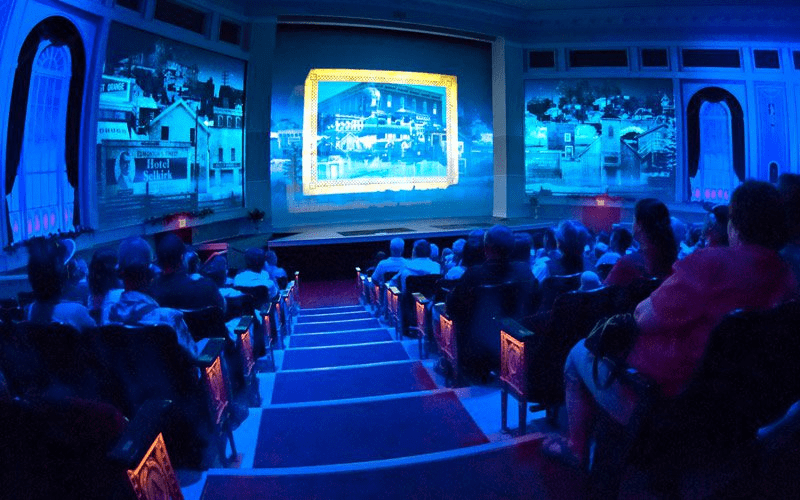
Today, the Capitol Theatre stands in Fort Edmonton Park, rebuilt to replicate the historical venue while integrating modern technology. The reconstruction project preserved authentic architectural elements of the original theatre while incorporating mechanical and electrical enhancements.
The redesign was managed by Williams Engineering, with the Visual Terrain team, led by renowned lighting designer Lisa Green, crafting a comprehensive architectural lighting plan to preserve the theatre’s historical authenticity.
The new Capitol Theatre officially opened in 2011. It now serves as a multi-functional entertainment venue, offering 4D experiences, dynamic seating, and live performances. The 1,250-square-meter facility accommodates 250 guests and features a spacious box office, a large entrance lobby, backstage areas, and a projection room.
A particularly unique feature of the theatre is its motion-enhanced seating, which vibrates during thrilling or suspenseful movie scenes. Additionally, snow machines are installed in the auditorium to create a gentle snowfall effect, while a steam pipe replicates the sound and feel of a passing locomotive, enhancing the realism of certain scenes.
With its blend of historic charm and cutting-edge technology, the Capitol Theatre continues to offer a unique cinematic experience, ensuring its place as a treasured landmark in Edmonton’s entertainment history.